SOMETIMES WE HUMANS GO ABOUT A TASK WITH TOOLS AND METHODS THAT ARE CLEARLY OUTDATED OR MISALIGNED WITH OUR ACTUAL OBJECTIVES
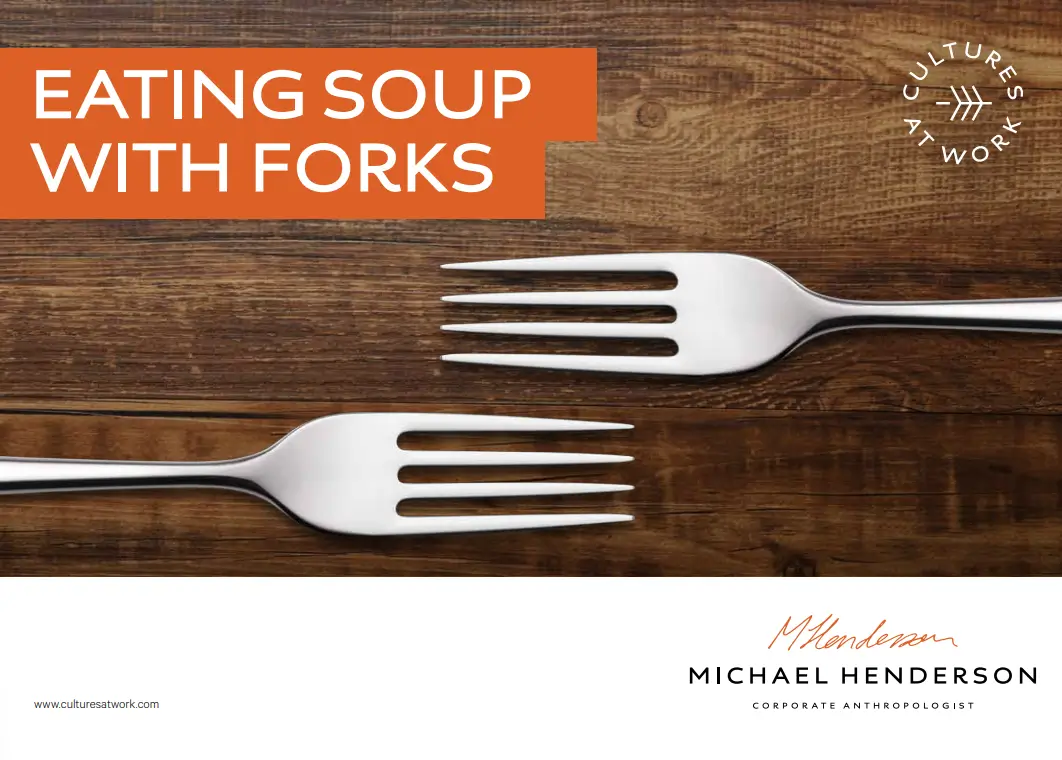
Rather like eating a bowl of soup with a fork.
Forks are great, forks are awesome – especially when you wish to pierce something solid on your plate or perhaps when you want to hold a piece of food in place so that you can cut it up into manageable portions. However, forks are just a waste of time when it comes to eating soup, especially soup that is predominantly liquid and not filled with delicious chunks of vegetables or meat.
Do you know what else is a fork? Using employee engagement surveys to measure and learn about company culture. The aim? To interpret the results, eventually using them to determine how to provide higher levels of employee fulfilment, enhance customer experience and lift business performance. But it’s inefective.
A fork has a set number of prongs, which can only stab at a specific range content to achieve the objective of obtaining and tasting the desired food. In the same way, a survey has a set number of questions that assume to be the right ones to ask. Then all of a sudden, you’re the king of culture.

In January 2016, The Gallup Organization celebrated its fifteenth year of delivering engagement surveys around the world, with the brave confession that in all those years from 2001 – 2016, staf levels of engagement had on average only increased by 2%.
It’s time to put down the fork and pick up the spoon of culture understanding and engagement. The spoon of culture is the rather obvious approach when educating the people who inhabit the culture about its make-up and function. In this way, “the spoon way”, people can delve deep into the subject and gather a collectively wider knowledge and understanding about culture. In this way, they can determine for themselves such vital information for working with culture as being aware of:
- How culture forms
- Who actually owns culture?
- What are daily rituals vital for keeping the culture alive and efective?
- How culture can be seen and used to boost job satisfaction and customer experience
- The daily function of culture and how it delivers the level of performance to the organisation
- Who leads culture and when do they do this?
- How culture aligns to support or sabotage a business strategy


If you are just ticking the box when it comes to culture please do not contact us and enjoy your fork.